
Osceola
Regie:
Konrad Petzold,
108 Min.,
Farbe,
Spielfilm
Deutsche Demokratische Republik (DDR)
DEFA-Studio für Spielfilme,
1971
- Film-/Videoformat
- 35 mm
- Länge in m
- 2976
- Englischer Titel
- Osceola
- Premierendatum
- Anlaufdatum

(R: Konrad Petzold, 1971) Grafiker: El Labbad
Kurzinhalt (Deutsch)
Florida, Anfang der 1830er-Jahre: Der skrupellose Plantagenbesitzer Raynes beutet seine versklavten Arbeiter aus, um den Profit beim Zuckerrohranbau zu maximieren. Dass viele Versklavte fliehen und beim Stamm der Seminolen Unterschlupf finden, ist ihm ein Dorn im Auge. Sein größter Gegenspieler ist der Sägewerksbesitzer Moore, der mit einer Seminolin zusammenlebt und die Sklaverei ablehnt. Die Lage in der Region spitzt sich zu, als die US-Regierung die Vertreibung der Seminolen und aller bei ihnen lebenden Flüchtlinge anordnet. Raynes plant einen Hinterhalt, um die einstigen Sklaven zurückzuholen. Kann Osceola die Eskalation verhindern?
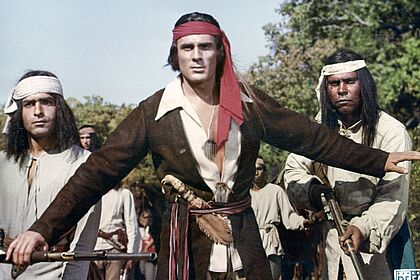
(R: Konrad Petzold, 1971) Fotografen: Manfred Damm, Detlef Hertelt
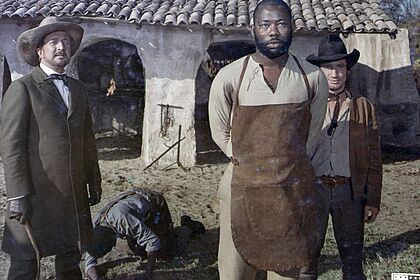
(R: Konrad Petzold, 1971) Fotografen: Manfred Damm, Detlef Hertelt
Filmstab
- Regie
-
- Konrad Petzold
- Drehbuch
-
- Günter Karl
- Walter Püschel
- Szenarium
-
- Günter Karl
- Walter Püschel
- Kamera
-
- Hans Heinrich
- Schnitt
-
- Thea Richter
- Darsteller
-
- Gojko Mitić (Osceola)
- Horst Schulze (geb. 1921) (Raynes)
- Iurie Darie (Moore)
- Karin Ugowski (Gladis)
- Kati Bus (Zilla)
- Pepa Nikolova (Rhea)
- Iskra Radewa (Che-Cho-Ter)
- Aubrey Pankey (Benjamin)
- William Aniche (Robin)
- Boubacar Touré (Black Panther)
- Josef Quartey (Tom)
- Almany Soumaré (Joshua)
- Gerhard Rachold (Hammer)
- Werner Kanitz (Phipps)
- Gerry Wolff (Gouverneur)
- Wolfgang Greese (Thompson)
- Bruno Carstens (Clinch)
- Kurt Kachlicki (Stock)
- Monika Woytowicz (Peggy Kerry)
- Daniel Michev (Emathla)
- Stefan Peitschev (Mikonopi)
- Ivan Dorin (Arpeika)
- Predrag Milinković (Captain Fletcher)
- Jürgen Frohriep (Leutnant)
- Fritz Mohr (Sergeant)
- Willi Neuenhahn (Maschinist)
- Frank Plange (Heizer)
- Bodo Schmidt (Wirt)
- Diawara Dramané (Arbeiter bei Moore)
- Gerhard Neubauer (Posten (Kellergefängnis))
- Klaus Schwarz (Posten (Kellergefängnis))
- Günter Schubert (Betrunkener Farmer)
- Wilfried Zander (Reiter)
- Victor Keune (Festredner)
- Wilfried Pucher (Munitionsschlepper)
- Heinz Laggies (Munitionsoffizier)
- Günter Ringe (Kanonier)
- Eckhard Bilz (Junger Leutnant)
- Erich Thiede (Bewacher)
- Iskra Apostelova (Seminolenmädchen)
- Heinz Fröhlich (Zapfer)
- Werner Schmidt-Winkelmann (Farmer)
- Konrad Petzold (Farmer)
- Hans Feldner (Farmer)
- Otto Schröder (Bewaffneter)
- Günter Herold (Bewaffneter)
- Georg Paplomatas (Posten am Fluss)
- Regieassistenz
-
- Thomas Jahn
- Ludmilla Koewa
- Szenenbild
-
- Heinz Röske
- Dramaturgie
-
- Hans-Joachim Wallstein
- Musik
-
- Wilhelm Neef
- Ton
-
- Peter Dienst
- Georg Gutschmidt
- Musikinterpret
-
- Bianca Cavallini (Gesang)
- Etta Cameron (Gesang)
- Kostüm
-
- Günther (auch Günter) Heidemann (geb. Schmidt, auch Schmidt-Heidemann)
- Marianne Schmidt
- Maske
-
- Lothar Stäglich
- Christa (auch: Christel) Grewald
- Peter Kuhnert
- Produktionsleitung
-
- Dorothea Hildebrandt
- Aufnahmeleitung
-
- Gerrit List
- Ursula Dombrowski
- Gestaltung
-
- Gisela Walther (Choreografie)
- Beratung
-
- Lothar Dräger
- Rolf Krusche
- DEFA-Fotograf
-
- Manfred Damm
- Detlef Hertelt
- Synchronisation (Sprecher)
-
- Gerhard Paul (Osceola)
- Horst Schön (Moore)
- Evelyn Opoczynski (Zilla)
- Barbara Dittus (Rhea)
- Renate Rennhack (Che-Cho-Ter)
- Lothar Schellhorn (Robin)
- Jürgen Kluckert (Black Panther)
- Hans-Peter Reinecke (Tom)
- Hans Hardt-Hardtloff (Mikonopi)
- Karl Sturm (Apeika)
Kurzinhalt (Englisch)
The Seminolian Indians are the only tribe to refuse deportation to a reservation. But, devoting themselves to farming and stock breeding in the state of Florida, they are in the way of the white plantation owners. These Whites not only endeavour to get the Indians' land, but they also refuse to tolerate any longer the situation of ever more black slaves escaping form the plantations to join up with the Seminolians. Thus, the government has decided to resettle them in the state of Oklahoma. Farmer William Raynes, a corrupt slaveholder, demands, however, that all former slaves remain in Florida and be returned to their owners. This standpoint incites public opinion against Moore, a sawmill owner and enlightened Northerner, who not only rejects slavery but also seeks to bring about a peaceful settlement. On their way to Oklahoma, the Seminolians have no idea what the Whites have in store for them: to ambush and kill every single one. Recognizing the impending danger, Chief Osceola warns his people. Only those few who disregard his warning are killed as they attempt to cross the river. Meanwhile, the government has sent the gunboat "Puma" into the area in order to cut off the Indians' escape route. Osceola manages to blow up the boat. During the explosion, Moore's sawmill catches fire and is reduced to ashes. These events of I 845 sparked the eight-year Seminolian Indian War.
Source: Progress Film-Verleih
Kurzinhalt (Weitere Sprachen)
Dopo essersi opposti al trasferimento in una riserva, gli indiani Seminole si ritirano in Florida coltivando campi e allevando bestiame. Ma la loro presenza disturba gli agricoltori bianchi, che puntano alle loro terre e si sentono minacciati dal fatto che sempre più schiavi di colore fuggano per rifugiarsi nella tribù. Moore, il proprietario di una segheria, sposato con un'indiana Seminole, è a favore di un accordo pacifico e contro la schiavitù, mentre Raynes, proprietario di una piantagione, sarebbe per sterminarli con un intervento militare. Il Capo Osceola, riconoscendo il pericolo, cerca di evitare le provocazioni dei bianchi, senza tuttavia impedire lo scoppio della guerra (1835). (Italienisch)
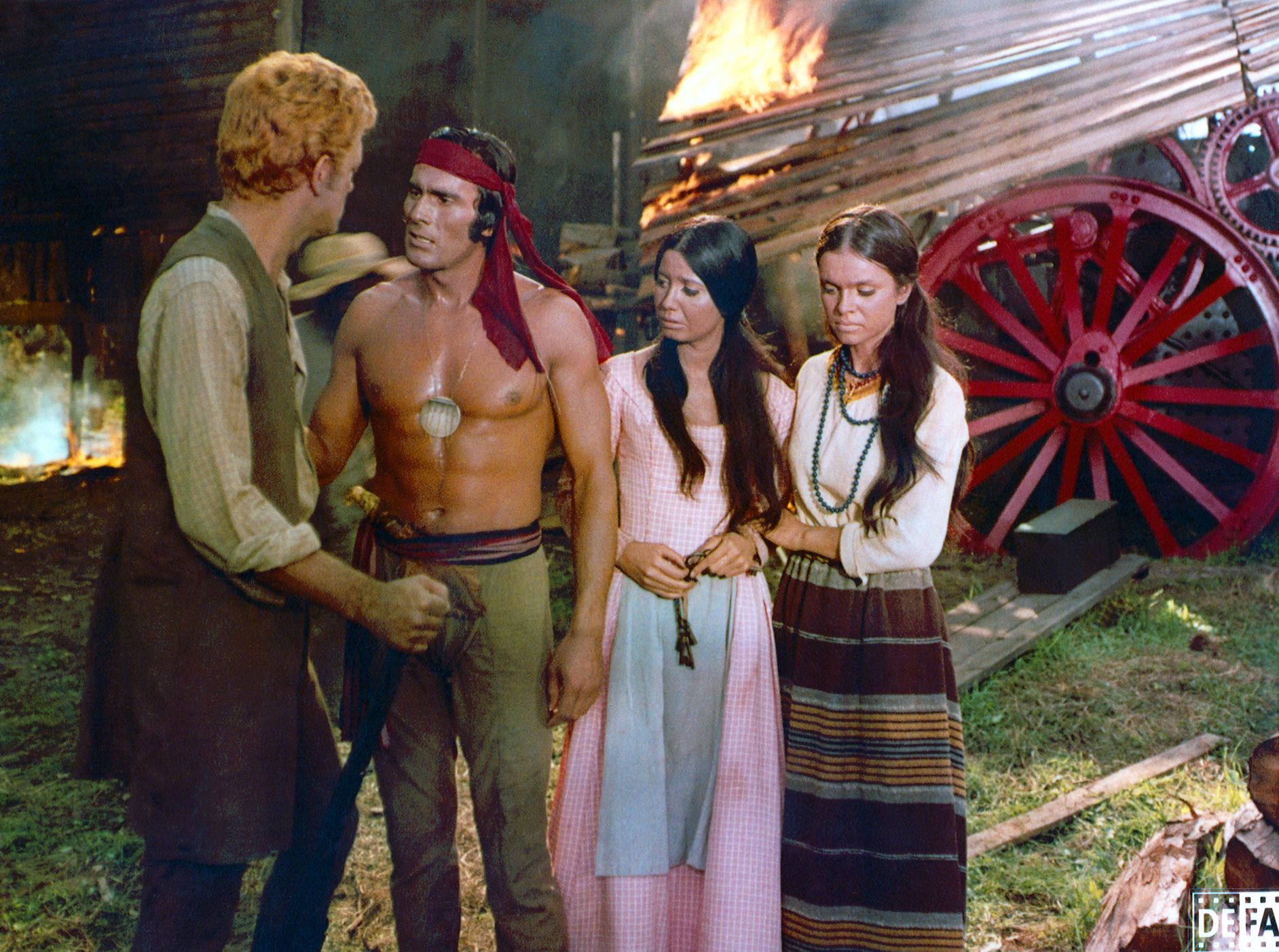
(R: Konrad Petzold, 1971) Fotografen: Manfred Damm, Detlef Hertelt

(R: Konrad Petzold, 1971) Fotografen: Manfred Damm, Detlef Hertelt

(R: Konrad Petzold, 1971) Fotografen: Manfred Damm, Detlef Hertelt